
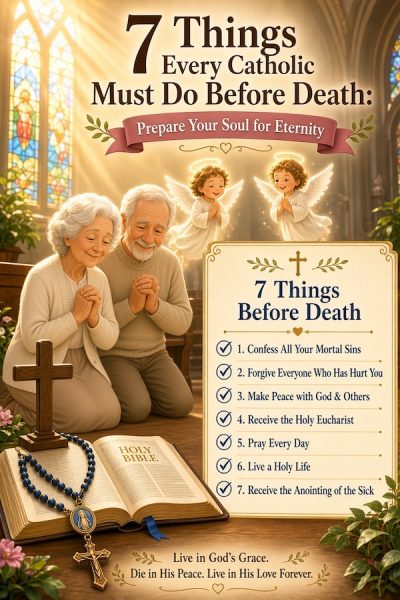
7 Things Every Catholic Must Do Before Death: Prepare Your Soul for Eternity
Have you prepared your soul to meet God? As Catholics, we believe that our earthly life is a precious gift, but it is not our final destination. God created us for Himself, and our ultimate purpose is to live with Him forever in Heaven.
Death is something that every human being must face. Yet, as Christians, we do not need to live in fear of death. Jesus Christ conquered death through His Resurrection and opened the way to eternal life for all who believe in Him and follow His teachings.
However, we must never take God’s mercy for granted or postpone our conversion. Every day is an opportunity to return to God, seek His forgiveness, forgive others, receive the Holy Eucharist, and grow in holiness.
The Catholic Church teaches us that our earthly life is a time of preparation for eternity. We are called to examine our hearts, repent of our sins, live according to God’s commandments, and remain faithful to Jesus Christ.
Here are seven important things every Catholic should do before death to prepare their soul to meet God.
1. Confess All Your Mortal Sins and Return to God’s Mercy
One of the most important things a Catholic should do before death is to repent of all serious sins and receive the Sacrament of Reconciliation.
Sin separates us from God, especially mortal sin, which destroys charity in the heart and deprives us of sanctifying grace. The Catholic Church teaches that three conditions must be present for a sin to be mortal:
- The sin must involve grave matter.
- The person must have full knowledge that it is seriously wrong.
- The person must give deliberate consent.
We should never allow shame, pride, or fear to prevent us from approaching the Sacrament of Confession. Jesus gave His Church the ministry of forgiveness so that sinners could return to the Father and receive His mercy.
In the Gospel of John, Jesus gave His apostles the authority to forgive sins:
John 20:22–23:
“Receive the Holy Spirit. Whose sins you forgive are forgiven them, and whose sins you retain are retained.”
Through the ministry of priests, Christ continues to offer forgiveness in the Sacrament of Reconciliation.
The Catechism of the Catholic Church (CCC 1422) teaches that those who approach the Sacrament of Penance obtain pardon from God’s mercy for the offenses committed against Him and are reconciled with the Church.
Do not wait until tomorrow to confess your sins. Examine your conscience, approach a priest, confess your sins honestly, express genuine sorrow, and receive God’s forgiveness.
If you are conscious of mortal sin, the Church teaches that you must receive sacramental absolution before receiving Holy Communion, unless the exceptional circumstances described in Church teaching apply.
Remember: No sin is greater than God’s mercy when we sincerely repent and turn back to Him.
2. Forgive Everyone Who Has Hurt You
Before we leave this world, we should make every effort to forgive those who have hurt us, betrayed us, rejected us, or treated us unfairly.
Forgiveness is not always easy. Sometimes the wounds we carry are deep, and the people who hurt us may never apologize. Nevertheless, Jesus teaches us that forgiveness is essential to the Christian life.
In the Lord’s Prayer, we pray:
Matthew 6:12:
“And forgive us our debts, as we forgive our debtors.”
Jesus also reminds us:
Matthew 6:14–15:
“For if you forgive others their transgressions, your heavenly Father will forgive you.”
As Catholics, we are called to imitate Christ, who forgave even those who crucified Him.
Forgiveness does not mean pretending that evil never happened. It does not mean accepting abuse, abandoning justice, or placing ourselves in dangerous situations. We can forgive someone while maintaining appropriate boundaries.
Forgiveness means surrendering hatred, resentment, and the desire for revenge to God. It means asking the Lord to heal our hearts and help us love as He loves.
Before death, ask yourself:
- Is there someone I refuse to forgive?
- Am I carrying anger or resentment in my heart?
- Have I hurt someone and refused to apologize?
- Do I need to ask someone for forgiveness?
Do not allow hatred to occupy the place in your heart that belongs to God.
Ask Jesus to give you the grace to forgive, even when it is difficult.
3. Make Peace with God and Reconcile with Others
Our relationship with God should be the most important relationship in our lives.
Sometimes we become so occupied with work, money, family responsibilities, entertainment, and worldly concerns that we forget to spend time with our Creator.
Yet our souls were made for God. No earthly possession, achievement, or pleasure can replace the peace that comes from being reconciled with Him.
The prophet Isaiah reminds us:
Isaiah 55:6:
“Seek the LORD while he may be found, call him while he is near.”
Making peace with God means turning away from sin, returning to His commandments, seeking His forgiveness, and placing our trust in His love.
It also means making peace with the people around us whenever possible.
If you have wounded a family member, ask for forgiveness. If you have spoken unjustly about someone, acknowledge your mistake. If you have neglected someone who needed your help, make an effort to repair that relationship.
Jesus teaches us the importance of reconciliation in Matthew 5:23–24. He tells His disciples that if they remember that someone has something against them, they should first seek reconciliation before presenting their offering at the altar.
We should not allow pride to prevent us from saying, “I am sorry.”
Life is short, and we do not know how much time we have. Make peace today. Do not wait for the perfect moment.
4. Receive the Holy Eucharist and Remain Close to Jesus
The Holy Eucharist is the source and summit of the Christian life.
As Catholics, we believe that Jesus Christ is truly present in the Holy Eucharist: Body, Blood, Soul, and Divinity. When we receive Holy Communion worthily, we receive Jesus Himself.
The Eucharist strengthens our relationship with Christ, nourishes our souls, and gives us grace to live as His disciples.
Jesus declared:
John 6:54:
“Whoever eats my flesh and drinks my blood has eternal life, and I will raise him on the last day.”
These words remind us of the extraordinary gift Jesus gave to His Church.
The Catechism of the Catholic Church (CCC 1324) teaches that the Eucharist is “the source and summit of the Christian life.”
Every Catholic should make the Holy Mass an essential part of life, especially by attending Mass on Sundays and holy days of obligation, according to the Church’s precepts.
We should also receive Holy Communion frequently, provided we are properly disposed and not conscious of unconfessed mortal sin.
As we approach the end of our earthly journey, the Church offers a special gift called Viaticum.
Viaticum is Holy Communion received by a person who is approaching death. It is spiritual nourishment for the final journey from this life to eternal life.
The Catechism (CCC 1524) teaches that the Eucharist received at the moment of passing from this world to the Father is the seed of eternal life and the power of resurrection.
Never take the gift of the Eucharist for granted. Jesus wants us to remain close to Him.
5. Pray Every Day and Strengthen Your Relationship with God
Prayer is not simply something we do when we are in trouble. Prayer is our daily conversation with God.
We should never allow a day to pass without turning our hearts toward the Lord.
Through prayer, we thank God for His blessings, ask forgiveness for our sins, bring Him our worries, and seek His guidance.
Jesus Himself taught His disciples the importance of prayer.
Luke 18:1:
“Then he told them a parable about the necessity for them to pray always without becoming weary.”
A Catholic should develop a daily habit of prayer, even when life becomes busy.
You can strengthen your spiritual life through:
- Praying the Our Father, Hail Mary, and Glory Be.
- Reading and meditating on the Holy Bible.
- Praying the Holy Rosary.
- Offering prayers of thanksgiving and repentance.
- Participating in Eucharistic Adoration.
- Praying for your family, the sick, the poor, and those who have died.
- Asking the saints to intercede for you.
Prayer helps us recognize God’s presence in our lives. It teaches us humility, patience, love, and trust.
We should also remember that prayer is not only about asking God for favors. It is about loving Him, listening to Him, and surrendering our lives to His divine will.
As we grow older, our prayers should become even more centered on eternity. Ask the Lord to prepare your heart, strengthen your faith, and help you remain faithful until the end.
6. Prepare Your Soul for Eternity by Living a Holy Life
One of the greatest mistakes we can make is to live as though this world were our permanent home.
Our earthly life is temporary. Our eternal destiny matters more than any temporary success or possession.
The Bible reminds us:
Hebrews 9:27:
“Just as it is appointed that human beings die once, and after this the judgment.”
These words remind us that our lives have eternal significance. We will stand before God, and our earthly choices matter.
Jesus also teaches us to store up treasures in Heaven rather than becoming attached to earthly riches.
Matthew 6:19–20:
“Do not store up for yourselves treasures on earth, where moth and decay destroy, and thieves break in and steal. But store up treasures in heaven.”
How do we prepare our souls for eternity?
We prepare by loving God above everything, obeying His commandments, serving others, practicing charity, avoiding sin, and remaining faithful to the Gospel.
We should examine our lives and ask:
- Am I living according to the teachings of Jesus?
- Do I love God with all my heart?
- Do I help the poor and those in need?
- Do I practice humility and kindness?
- Do I attend Mass and receive the Sacraments?
- Am I growing in holiness every day?
The Catholic Church teaches that death brings our earthly life to an end and that each person receives the particular judgment immediately after death (CCC 1021–1022).
This is why we must take our spiritual lives seriously.
We do not know the day or hour when God will call us home. Therefore, we should live each day prepared to meet Him.
Our hope is not in our own perfection, but in the mercy of Jesus Christ, who calls us to repentance and gives us the grace to become holy.
7. Anointing of the Sick and the Sacraments Before Death
Every Catholic should understand the importance of receiving the Sacraments when seriously ill or approaching death.
The Church offers the Sacrament of the Anointing of the Sick to those who are seriously ill because of sickness or old age. It is not reserved only for the final moments of life.
Through this Sacrament, Christ offers spiritual strength, peace, courage, and forgiveness. It may also bring physical healing if God wills.
The Apostle James writes:
James 5:14–15:
“Is anyone among you sick? He should summon the presbyters of the church, and they should pray over him and anoint him with oil in the name of the Lord.”
The Catechism of the Catholic Church (CCC 1514) teaches that the Anointing of the Sick is not only for those who are at the point of death. A person may receive it when they begin to be in danger due to sickness or old age.
When someone is approaching death, the Church encourages the reception of the Sacraments whenever possible:
- Confession: To receive God’s forgiveness and be reconciled with Him.
- Anointing of the Sick: To receive Christ’s grace, strength, and spiritual healing.
- Holy Communion (Viaticum): To receive Jesus Christ as spiritual nourishment for the final journey.
These Sacraments are beautiful signs of God’s love and mercy. They remind us that we are never alone, even in our final moments.
If a loved one is seriously ill, do not wait until the last minute to contact a priest. Ask for pastoral care and the opportunity to receive the Sacraments.
The Church wants every person to face death with faith, hope, and the comfort of Christ.
A Final Reflection: Are You Ready to Meet God?
We should not wait until old age, illness, or the final moments of life to repent, forgive, pray, and return to the Lord.
Today is the right time to make peace with God.
Go to Confession. Forgive those who have hurt you. Ask forgiveness from those you have wounded. Attend Holy Mass. Receive the Holy Eucharist worthily. Pray every day. Help those in need. Love your family. Live according to the Gospel.
Most importantly, never lose hope in the mercy of Jesus Christ.
A Catholic Prayer to Prepare Our Souls for Eternity
Heavenly Father,
I come before You with a humble and repentant heart. Thank You for the gift of life, for Your endless mercy, and for the love You have shown me throughout my earthly journey.
Lord Jesus Christ, forgive me for all my sins, especially the sins I have committed knowingly and willingly. Wash me clean through Your Precious Blood and lead me back to Your loving heart.
Give me the grace to forgive everyone who has hurt me, and help me ask forgiveness from those whom I have wounded.
Strengthen my faith, deepen my love for the Holy Eucharist, and teach me to pray with sincerity every day.
Holy Spirit, guide my steps, protect my soul from sin, and help me live according to God’s holy commandments.
Blessed Virgin Mary, Mother of God, pray for me now and at the hour of my death. Help me remain close to your Son, Jesus Christ.
Lord, when my earthly journey comes to an end, may I be found faithful to You. Grant me the grace of a peaceful death, surrounded by Your mercy and love.
May I one day enter Your heavenly Kingdom and rejoice in Your presence forever.
In the name of the Father, and of the Son, and of the Holy Spirit.
Amen.
Remember: Do not wait until tomorrow to make peace with God. Begin today. Your soul is precious, and eternity is forever.
Leave us your prayers…