
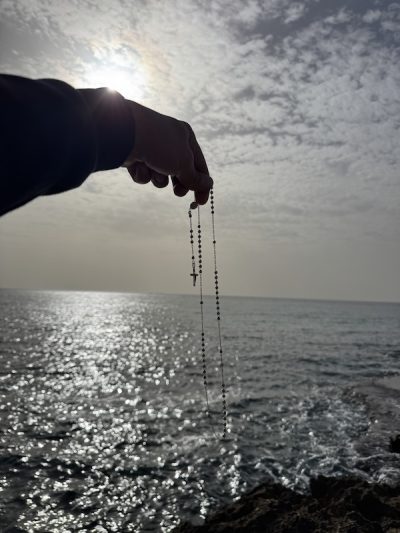
The Holy Rosary is one of the most beloved devotions in the Catholic Church. For centuries, Catholics throughout the world have prayed the Rosary to honor the Blessed Virgin Mary, meditate on the life of Jesus Christ, and seek Mary’s intercession in their daily lives.
Whether you are learning how to pray the Rosary for the first time or wish to deepen your devotion, this guide will teach you how to pray it step by step. You will discover the traditional Rosary prayers, learn the three original sets of Mysteries, and understand how to meditate on the principal events of Our Lord’s life.
The Rosary is a beautiful prayer for individuals, families, and Catholic communities. You can offer it for a particular intention, for the conversion of sinners, for peace in the world, for the souls in Purgatory, or in thanksgiving for God’s blessings.
At its heart, the Rosary is a Christ-centered devotion. Through the intercession of the Blessed Virgin Mary, we contemplate the mysteries of our salvation and seek to follow Jesus more faithfully.
What Is the Holy Rosary?
The Holy Rosary is a traditional Catholic devotion that combines vocal prayers with meditation on important events in the lives of Jesus Christ and His Blessed Mother.
The Rosary is traditionally divided into three sets of Mysteries:
- The Joyful Mysteries, which focus on the Incarnation and the early life of Jesus.
- The Sorrowful Mysteries, which recall the suffering and death of Our Lord.
- The Glorious Mysteries, which celebrate the Resurrection of Jesus and the glory of Christ and His Mother.
Each set contains five Mysteries, and each Mystery is accompanied by a decade of the Rosary, consisting of one Our Father, ten Hail Marys, and one Glory Be.
A complete five-decade Rosary takes approximately 15–25 minutes, depending on your pace and the time you spend meditating.
Although the Rosary honors the Blessed Virgin Mary, its central focus is Jesus Christ. As we pray the Hail Mary, we reflect on His Incarnation, public ministry, Passion, death, and Resurrection.
The repeated prayers help us enter into a spirit of contemplation, allowing the Gospel events to shape our hearts and strengthen our faith.
How to Pray the Rosary Step by Step
You do not need to be an experienced Catholic to begin praying the Rosary. Follow these traditional steps, and with practice, the prayers and sequence will become familiar.
Step 1: Make the Sign of the Cross
Begin by holding the crucifix and making the Sign of the Cross.
In the Name of the Father, and of the Son, and of the Holy Spirit. Amen.
Take a moment to place yourself in God’s presence. Quiet your thoughts and offer this Rosary for your particular intention.
You may pray for your family, someone who is ill, peace in the world, the conversion of a loved one, or any other spiritual need.
Step 2: Pray the Apostles’ Creed
Holding the crucifix, pray the Apostles’ Creed:
I believe in God, the Father almighty, Creator of heaven and earth; and in Jesus Christ, His only Son, our Lord, who was conceived by the Holy Spirit, born of the Virgin Mary, suffered under Pontius Pilate, was crucified, died, and was buried. He descended into hell; on the third day He rose again from the dead. He ascended into heaven and is seated at the right hand of God the Father almighty; from there He will come to judge the living and the dead.
I believe in the Holy Spirit, the holy Catholic Church, the communion of saints, the forgiveness of sins, the resurrection of the body, and life everlasting. Amen.
The Apostles’ Creed expresses the essential beliefs of the Christian faith and prepares us to meditate on the mysteries of our salvation.
Step 3: Pray the Our Father
On the first bead after the crucifix, pray the Our Father:
Our Father, who art in heaven, hallowed be Thy name; Thy kingdom come; Thy will be done on earth as it is in heaven. Give us this day our daily bread; and forgive us our trespasses, as we forgive those who trespass against us; and lead us not into temptation, but deliver us from evil. Amen.
This prayer was taught by Jesus Himself. We praise our heavenly Father, ask for His kingdom to come, seek our daily needs, and ask for forgiveness and protection from evil.
Step 4: Pray Three Hail Marys
On the next three beads, pray one Hail Mary on each bead.
Traditionally, these three Hail Marys are offered for an increase in faith, hope, and charity.
Hail Mary, full of grace, the Lord is with thee. Blessed art thou among women, and blessed is the fruit of thy womb, Jesus. Holy Mary, Mother of God, pray for us sinners, now and at the hour of our death. Amen.
Pray the Hail Mary three times, asking God to strengthen your faith, deepen your hope, and increase your love for Him and your neighbor.
Step 5: Pray the Glory Be
On the next bead, pray the Glory Be:
Glory be to the Father, and to the Son, and to the Holy Spirit, as it was in the beginning, is now, and ever shall be, world without end. Amen.
This prayer gives glory to the Most Holy Trinity: the Father, the Son, and the Holy Spirit.
Step 6: Announce the First Mystery
Before beginning the first decade, announce the first Mystery for the day.
For example, if you are praying the Joyful Mysteries, the first Mystery is the Annunciation, when the Angel Gabriel announced to the Blessed Virgin Mary that she would conceive and bear the Son of God.
Pause briefly to reflect on this event. You may consider a passage from Scripture, imagine the Gospel scene, or reflect on the virtues shown by Jesus and Mary.
Then pray the Our Father on the bead before the first group of ten beads.
Step 7: Pray Ten Hail Marys
On each of the next ten beads, pray one Hail Mary.
As you pray, meditate on the Mystery you have announced. Try to keep your thoughts focused on the life of Christ rather than rushing through the words.
The repetition of the Hail Mary is intended to help you enter more deeply into prayer. If your mind wanders, gently return your attention to the Mystery and continue praying.
Step 8: Pray the Glory Be and the Optional Fatima Prayer
After the ten Hail Marys, pray the Glory Be:
Glory be to the Father, and to the Son, and to the Holy Spirit, as it was in the beginning, is now, and ever shall be, world without end. Amen.
Many Catholics also pray the Fatima Prayer after each decade:
O my Jesus, forgive us our sins, save us from the fires of hell, lead all souls to Heaven, especially those who are most in need of Thy mercy.
This prayer is a familiar addition associated with the apparitions of Our Lady of Fatima. It is customary in many communities, but it is not essential to the basic structure of the Rosary.
Step 9: Complete the Remaining Four Decades
Continue in the same manner until you have prayed all five decades.
For each decade:
- Announce the next Mystery.
- Pause for meditation.
- Pray the Our Father.
- Pray ten Hail Marys.
- Pray the Glory Be.
- Pray the Fatima Prayer if you follow this custom.
Remember that the Rosary is not simply a repetition of words. It is an invitation to contemplate the life of Jesus with the Blessed Virgin Mary and to allow the Gospel to transform your life.
Step 10: Pray the Hail, Holy Queen
After completing the five decades, conclude with the Hail, Holy Queen:
Hail, Holy Queen, Mother of mercy, our life, our sweetness, and our hope. To thee do we cry, poor banished children of Eve. To thee do we send up our sighs, mourning and weeping in this valley of tears. Turn, then, most gracious Advocate, thine eyes of mercy toward us, and after this our exile show unto us the blessed fruit of thy womb, Jesus. O clement, O loving, O sweet Virgin Mary.
Pray for us, O holy Mother of God, that we may be made worthy of the promises of Christ.
You may then pray the traditional concluding prayer:
Let us pray. O God, whose only-begotten Son, by His life, death, and Resurrection, has purchased for us the rewards of eternal life, grant, we beseech Thee, that meditating upon these mysteries of the Most Holy Rosary of the Blessed Virgin Mary, we may imitate what they contain and obtain what they promise, through the same Christ our Lord. Amen.
Finish by making the Sign of the Cross.
You have now completed the traditional five-decade Rosary.
The Three Traditional Mysteries of the Holy Rosary
The traditional Rosary consists of three sets of Mysteries: the Joyful, Sorrowful, and Glorious Mysteries. Together, they guide us through the principal events of Christ’s life, from His Incarnation to His Resurrection and glory.
Each set contains five Mysteries. When praying the traditional Rosary, you meditate on one set of five Mysteries each day.
1. The Joyful Mysteries
The Joyful Mysteries focus on the Incarnation and the early life of Jesus Christ. They invite us to contemplate Mary’s humility, her obedience to God, and the wonder of the Son of God becoming man.
The Joyful Mysteries are traditionally prayed on Mondays and Thursdays.
The Five Joyful Mysteries are:
- The Annunciation: The Angel Gabriel announces to Mary that she will conceive and bear the Son of God. (Luke 1:26–38)
- The Visitation: Mary visits her cousin Elizabeth, who recognizes the blessing of the Lord’s coming. (Luke 1:39–56)
- The Nativity: Jesus Christ is born in Bethlehem. (Luke 2:1–20)
- The Presentation in the Temple: Mary and Joseph present the Child Jesus to the Lord. (Luke 2:22–38)
- The Finding of Jesus in the Temple: Mary and Joseph find the twelve-year-old Jesus among the teachers in the Temple. (Luke 2:41–52)
As you pray these Mysteries, reflect on humility, charity, poverty of spirit, obedience, and devotion to Jesus.
2. The Sorrowful Mysteries
The Sorrowful Mysteries focus on the suffering and death of Our Lord Jesus Christ. They remind us of the great love Christ showed by offering Himself for our salvation.
The Sorrowful Mysteries are traditionally prayed on Tuesdays and Fridays.
The Five Sorrowful Mysteries are:
- The Agony in the Garden: Jesus prays in Gethsemane and accepts the will of His heavenly Father. (Matthew 26:36–46)
- The Scourging at the Pillar: Jesus is cruelly scourged. (Matthew 27:26)
- The Crowning with Thorns: The soldiers mock Jesus and place a crown of thorns upon His head. (Matthew 27:27–31)
- The Carrying of the Cross: Jesus carries His Cross toward Calvary. (John 19:16–17)
- The Crucifixion and Death of Our Lord: Jesus gives His life on the Cross for our salvation. (Luke 23:33–46)
These Mysteries invite us to meditate on Christ’s suffering, the seriousness of sin, the depth of God’s mercy, and the importance of patience, forgiveness, and sacrificial love.
When praying the Sorrowful Mysteries, remember that the Cross is not the end of the story. Christ’s sacrifice opens the way to the glory of the Resurrection.
3. The Glorious Mysteries
The Glorious Mysteries celebrate the Resurrection of Jesus Christ, His Ascension into Heaven, the coming of the Holy Spirit, and the glory of His Blessed Mother.
The Glorious Mysteries are traditionally prayed on Wednesdays, Saturdays, and Sundays.
The Five Glorious Mysteries are:
- The Resurrection: Jesus rises triumphantly from the dead. (Luke 24:1–12)
- The Ascension: Jesus ascends into Heaven. (Acts 1:6–11)
- The Descent of the Holy Spirit: The Holy Spirit descends upon Mary and the Apostles at Pentecost. (Acts 2:1–4)
- The Assumption of the Blessed Virgin Mary: Mary is assumed body and soul into heavenly glory.
- The Coronation of the Blessed Virgin Mary: Mary is crowned Queen of Heaven and Earth.
These Mysteries fill us with hope in Christ’s victory over sin and death. They remind us of the promise of eternal life and encourage us to remain faithful to God throughout our earthly journey.
The Assumption and Coronation also invite us to contemplate the special glory God has bestowed upon the Blessed Virgin Mary.
The Luminous Mysteries: An Optional Addition to the Traditional Rosary
The Luminous Mysteries are optional for Catholics who wish to follow the traditional three-set Rosary.
For centuries, the Rosary was commonly prayed with the Joyful, Sorrowful, and Glorious Mysteries. In 2002, Pope Saint John Paul II proposed an additional set of five Mysteries called the Luminous Mysteries, or Mysteries of Light.
This addition was intended to help the faithful meditate on important events in the public ministry of Jesus Christ. It did not replace the traditional Mysteries or change the essential structure of the Rosary.
Catholics may continue praying the traditional Rosary with its three sets of Mysteries. Those who wish to follow the additional devotion may include the Luminous Mysteries, traditionally prayed on Thursdays.
The Five Luminous Mysteries are:
- The Baptism of Jesus in the Jordan: The Father reveals Jesus as His beloved Son. (Matthew 3:13–17)
- The Wedding at Cana: Jesus performs His first public sign at the request of His Mother. (John 2:1–11)
- The Proclamation of the Kingdom of God: Jesus calls people to repentance and faith in the Gospel. (Mark 1:14–15)
- The Transfiguration: Jesus reveals His glory to Peter, James, and John. (Matthew 17:1–8)
- The Institution of the Holy Eucharist: Jesus gives His Body and Blood to His disciples at the Last Supper. (Matthew 26:26–28)
These Mysteries invite us to contemplate the public ministry of Christ, His call to conversion, and the gift of the Holy Eucharist.
If you prefer the traditional Rosary, you may simply pray the Joyful, Sorrowful, and Glorious Mysteries according to the traditional weekly schedule.
Which Mysteries of the Rosary Should You Pray Each Day?
For Catholics following the traditional three-set Rosary, the customary weekly schedule is:
| Day | Traditional Mysteries |
|---|---|
| Monday | Joyful Mysteries |
| Tuesday | Sorrowful Mysteries |
| Wednesday | Glorious Mysteries |
| Thursday | Joyful Mysteries |
| Friday | Sorrowful Mysteries |
| Saturday | Glorious Mysteries |
| Sunday | Glorious Mysteries |
This schedule reflects the traditional practice before the introduction of the Luminous Mysteries.
If you choose to include the optional Luminous Mysteries, the commonly used modern schedule is:
| Day | Mysteries |
|---|---|
| Monday | Joyful |
| Tuesday | Sorrowful |
| Wednesday | Glorious |
| Thursday | Luminous |
| Friday | Sorrowful |
| Saturday | Joyful |
| Sunday | Glorious |
The Rosary is a personal and communal devotion, and the traditional weekly schedule is a guide rather than a restriction. You may pray any set of Mysteries whenever you have a particular spiritual reason to do so.
How Long Does It Take to Pray the Rosary?
Praying a traditional five-decade Rosary usually takes about 15–25 minutes. The exact time depends on how quickly you pray and how much time you spend meditating on each Mystery.
If you are new to the Rosary, take your time learning the prayers. You may keep a written guide nearby until you become familiar with the sequence.
Some Catholics pray the Rosary in the morning, while others prefer the evening or a quiet moment during the day. Choose a time that allows you to pray without unnecessary distractions.
You can also pray the Rosary with your family or join other Catholics in communal prayer.
What matters most is not how quickly you finish, but that you pray with faith, attention, and love for God.
What Should You Pray the Rosary For?
The Rosary can be offered for many spiritual intentions, including:
- The protection and spiritual welfare of your family.
- Healing and consolation for the sick and suffering.
- Peace in the world and an end to war.
- The conversion of sinners and the growth of faith.
- The needs of the poor and persecuted Christians.
- The souls of the faithful departed.
- Guidance in difficult decisions.
- Thanksgiving for God’s blessings.
Before beginning the Rosary, present your intention to God and ask the Blessed Virgin Mary to intercede for you.
Remember that prayer is not a guarantee that every request will be granted exactly as we desire. The Rosary helps us entrust our needs to God with confidence, patience, and perseverance.
Why Is the Rosary Important in Catholic Life?
The Rosary helps Catholics contemplate the Gospel and reflect on the mysteries of salvation. By meditating on the life of Jesus with Mary, we are encouraged to imitate Christ’s humility, obedience, compassion, forgiveness, and sacrificial love.
The Rosary also strengthens our prayer life. Its familiar prayers can help us remain close to God during both joyful and difficult moments.
Although the Rosary is Marian in character, its center is Jesus Christ. The Blessed Virgin Mary always directs the faithful toward her Son. When Catholics ask for Mary’s intercession, they seek her maternal prayers as they strive to follow Christ.
The Rosary is not a magical formula. Its spiritual value lies in sincere prayer, meditation on the Gospel, and openness to God’s grace.
Can You Pray the Rosary Without Rosary Beads?
Yes. Rosary beads are a helpful aid, but they are not required to pray.
If you do not have a Rosary, you can count the prayers on your fingers or follow a written guide. You may also pray along with a recording or join a communal Rosary.
If you forget a prayer, do not become discouraged. Learn the prayers gradually and continue with a sincere heart.
The purpose of the Rosary is to help you meditate on Christ’s life and grow closer to God through prayer.
Pray the Holy Rosary Every Day
The Holy Rosary is a beautiful way to entrust your family, intentions, joys, and difficulties to God through the intercession of the Blessed Virgin Mary.
Whether you follow the traditional three sets of Mysteries or choose to include the optional Luminous Mysteries, the heart of the devotion remains the same: contemplating the life of Jesus Christ and seeking to follow Him more faithfully.
If you are new to the Rosary, begin today. You do not need to know every prayer by heart. Start with a sincere heart, follow the steps, and allow this traditional Catholic devotion to become part of your spiritual life.
If you already pray the Rosary, persevere in this beautiful devotion and encourage your family to pray with you whenever possible.
May the Blessed Virgin Mary intercede for us, protect our families, strengthen our faith, and lead us always closer to her Son, Our Lord Jesus Christ.
In the Name of the Father, and of the Son, and of the Holy Spirit. Amen.
Leave us your prayers…