
On the northern shore of the Sea of Galilee, in the beautiful region where Jesus called His first disciples, stands the ancient town of Capernaum. Known as the Town of Jesus, Capernaum holds a special place in the history of Christianity. It was here that Jesus made His home during much of His public ministry in Galilee, preached in the synagogue, healed the sick, called His Apostles, and performed many miracles.
But why did Jesus leave Nazareth, the town where He had grown up, and establish His ministry in Capernaum? What made this small fishing town so important?
The answer is connected not only to the Gospel accounts but also to the geography and history of the Holy Land. Capernaum occupied a strategic position near important commercial routes connecting Galilee with Damascus, Syria, the Jordan Valley, and other regions of the ancient Near East.
Where Is Capernaum?
Capernaum was an ancient Jewish fishing village situated on the northwestern shore of the Sea of Galilee, also known as the Lake of Gennesaret or the Sea of Tiberias.
Today, its archaeological remains are among the most important Christian pilgrimage sites in the Holy Land. Visitors can see the ruins of the ancient synagogue, the remains of first-century houses, and the traditional site of the house of Saint Peter, over which a modern church has been built.
During the time of Jesus, Capernaum was an active settlement with fishermen, farmers, merchants, tax collectors, and Roman officials. Its location beside the Sea of Galilee made fishing an important part of its economy.
It was also situated near an important road leading toward Damascus. This gave the town connections with travellers and merchants moving between Galilee and neighbouring territories.
Capernaum was therefore more than an ordinary fishing village. It was a place where people, cultures, and different communities met.
Why Did Jesus Leave Nazareth and Choose Capernaum?
Jesus was raised in Nazareth, a small town in the hills of Galilee. It was there that He spent His childhood and lived with the Blessed Virgin Mary and Saint Joseph.
However, when He began His public ministry, Jesus moved to Capernaum.
Saint Matthew records:
“After entering Capernaum, he made his home there.” (Matthew 4:13)
This move was not without meaning. Capernaum offered a very different setting from Nazareth. While Nazareth was a relatively secluded village in the hills, Capernaum was situated beside the Sea of Galilee and near important travel and trade routes.
From Capernaum, Jesus could reach fishing communities, neighbouring villages, and larger centres of population. News of His teaching and miracles could spread throughout Galilee and beyond.
The town was also home to several men who would become His Apostles. Peter and Andrew were fishermen, as were James and John. Jesus called them to leave their nets and follow Him.
Capernaum was also where Jesus called Matthew, the tax collector, to become His disciple.
The Gospel tells us:
“As he passed by, he saw Levi, son of Alphaeus, sitting at the customs post. He said to him, ‘Follow me.’ And he got up and followed him.” (Mark 2:14)
Jesus was bringing together people from different backgrounds and occupations to establish the foundation of His Church.
Capernaum: A Strategic Location Connecting Different Lands
One of the most interesting aspects of Capernaum is its geographical position.
The town stood near routes that connected Galilee with the northern and eastern regions of the ancient world. Its connections extended toward Damascus and Syria, the Jordan Valley, the Phoenician coast in the direction of present-day Lebanon, and wider trade networks reaching Mesopotamia, in modern-day Iraq.
It is important to understand that these were networks of roads and regional connections, not a single road directly connecting Capernaum with every one of these lands.
The nearby road toward Damascus was particularly significant. Merchants, travellers, officials, and soldiers passed through the wider region. Archaeological discoveries, including coins and pottery from different regions, provide evidence of Capernaum’s commercial connections.
The town also stood close to the frontier between the territory ruled by Herod Antipas and the territory governed by Philip. This frontier position gave it additional importance.
Why does this matter?
Because Jesus was not simply preaching to the people of one isolated village. His message was being proclaimed in a region connected to a much wider world.
The Gospel was first proclaimed among the people of Israel, but the mission of Christ would eventually reach every nation. Capernaum’s location provides a powerful historical setting for understanding how the message of Jesus could spread.
The Prophecy of Isaiah: A Great Light in Galilee
Saint Matthew gives us an especially important reason for Jesus’ move to Capernaum.
He explains that Jesus’ arrival fulfilled the prophecy of Isaiah:
“Land of Zebulun and land of Naphtali, the way to the sea, beyond the Jordan, Galilee of the Gentiles, the people who sit in darkness have seen a great light, on those dwelling in a land overshadowed by death light has arisen.” (Matthew 4:15–16)
This passage comes from Isaiah 9:1–2.
Matthew wants us to understand that the beginning of Jesus’ public ministry in Galilee was part of God’s plan. The light promised through the prophet Isaiah had come into the world through Jesus Christ.
Capernaum was located in the ancient territory associated with Naphtali, and its position near the Sea of Galilee made it especially significant in Matthew’s account.
The choice of Capernaum was therefore not merely a practical decision. Matthew presents it as the fulfilment of Scripture.
Jesus brought the light of salvation to a region that had known suffering, darkness, and the influence of different peoples and powers.
Capernaum, the Town Where Jesus Performed Many Miracles
Capernaum became one of the most important places in the Gospel accounts of Jesus’ public ministry.
Many remarkable events took place there.
Jesus healed the servant of a Roman centurion. The centurion demonstrated extraordinary faith, and Jesus praised him for trusting in His authority (Matthew 8:5–13).
Jesus healed Saint Peter’s mother-in-law. When Jesus entered Peter’s house, He found her suffering from a fever. He touched her hand, and the fever left her (Matthew 8:14–15).
Jesus healed a paralytic. When a paralyzed man was brought before Him, Jesus first forgave his sins and then commanded him to rise and walk (Mark 2:1–12).
Jesus cast out an unclean spirit in the synagogue. The people were astonished by His authority, even over evil spirits (Mark 1:21–27).
Jesus taught about the Bread of Life. In the Gospel of John, after the multiplication of the loaves, Jesus delivered His profound teaching about the Bread of Life. The Gospel places this teaching in the synagogue at Capernaum (John 6:22–59).
These events made Capernaum one of the most important places in the life of Jesus.
It was also a place where people witnessed His divine authority through His words, His compassion, and His miracles.
Why Did Jesus Call Capernaum His Own Town?
Saint Matthew gives Capernaum a remarkable description. After Jesus healed a paralytic, the Gospel says that He returned to His own town (Matthew 9:1).
This is significant because Jesus had grown up in Nazareth. Yet Capernaum became the place most closely associated with His public life in Galilee.
It became the home of His ministry and the place from which He travelled to preach in surrounding communities.
Capernaum was also the home of some of His closest disciples. The house traditionally identified as Saint Peter’s house became an important place of Christian remembrance.
The archaeological remains of a first-century house beneath the later Byzantine church have long been associated with this tradition. While archaeology cannot prove every detail of the identification, the site preserves an ancient Christian memory connected with Saint Peter and Jesus.
What Does the Name Capernaum Mean?
The ancient Hebrew name of Capernaum is generally understood as Kfar Nahum, meaning Village of Nahum.
The name Nahum is associated with the Hebrew root n-ḥ-m, which carries meanings connected with comfort, consolation, and being consoled.
Therefore, the name is often explained as the Village of Comfort or the Village of Consolation.
The name also brings to mind the Old Testament prophet Nahum, whose biblical book contains a prophecy concerning the destruction of Nineveh.
There is a traditional association between the Prophet Nahum and the town of Alqosh in northern Iraq, where a tomb identified with him has been venerated for centuries. However, the exact historical location of the prophet’s burial and the relationship between the prophet and Capernaum are not established with certainty.
There is no historical proof that Capernaum was named after the prophet himself. The most reliable translation of the town’s name remains Village of Nahum.
Nevertheless, the meaning associated with consolation offers a beautiful spiritual reflection. In Capernaum, Jesus brought comfort to the suffering, healing to the sick, forgiveness to sinners, and hope to those who needed God’s mercy.
Why Did Jesus Warn Capernaum?
Despite the many miracles performed there, not everyone in Capernaum accepted Jesus.
This makes the town’s story even more meaningful.
Jesus rebuked Capernaum because many of its inhabitants had witnessed His mighty works but had not truly repented.
He said:
“And as for you, Capernaum: ‘Will you be exalted to heaven? You will go down to the netherworld.’” (Matthew 11:23)
The warning teaches us an important lesson. Witnessing miracles and hearing the Word of God are not enough if a person refuses to change his or her heart.
Capernaum had received extraordinary spiritual blessings, but Jesus called its people to repentance.
This message remains relevant to Christians today. We are invited not only to hear the Gospel but to live according to it.
Visiting Capernaum Today: Walking in the Footsteps of Jesus
Today, Capernaum is one of the most moving places to visit in the Holy Land.
Standing among its ancient stones, one can imagine the fishermen preparing their nets, the people gathering in the synagogue, and Jesus walking through the streets to bring healing and hope.
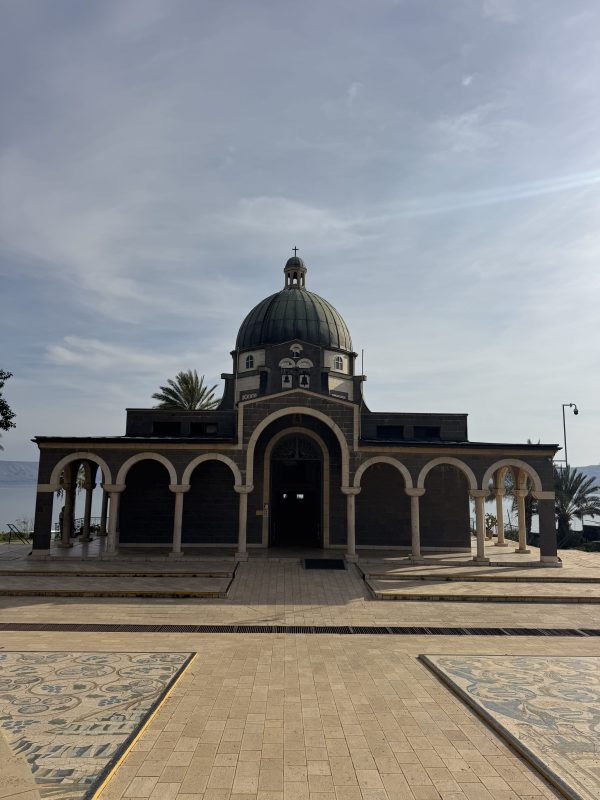
Visitors can explore the remains of the ancient synagogue, see the traditional site of Saint Peter’s house, and look out toward the Sea of Galilee.
The site is cared for by the Franciscan Custody of the Holy Land, while part of the archaeological area belongs to the Greek Orthodox Patriarchate.
For Christians, visiting Capernaum is more than visiting an archaeological site. It is an opportunity to reflect on the Gospel and remember the places where Jesus lived, taught, and called His first disciples.
A Prayer from the Town of Jesus
Lord Jesus Christ,
You chose Capernaum as a home for Your ministry and brought the light of Your Gospel to the people of Galilee.
You healed the sick, forgave sinners, called Your Apostles, and gave hope to those who suffered.
May the same light shine in our hearts today. Give us the faith of Saint Peter, the humility of Your disciples, and the courage to follow You wherever You lead us.
May we never become like those who witnessed Your works but refused to repent. Help us to listen to Your Word, receive Your mercy, and live faithfully according to Your teachings.
Amen.
Capernaum will always remain the Town of Jesus: a place where the light of Christ first shone brightly across Galilee and where the Gospel began its journey toward the nations.
Leave us your prayers…