
The Catholic Church in Rome has a history that reaches back to the earliest days of Christianity. Its origins are not rooted in the power of the Roman Empire, the authority of an emperor, or the decisions of later political leaders. They are rooted in Jesus Christ, His Apostles, and the mission He entrusted to them to proclaim the Gospel to the entire world.
One remarkable passage in the Acts of the Apostles reveals the importance of Rome in God’s plan for spreading Christianity. During a difficult moment in the life of Saint Paul, the Lord Himself appeared to him and promised that he would bear witness to the Gospel in Rome.
The Bible tells us:
“Take courage! As you have testified about me in Jerusalem, so you must also testify in Rome.” (Acts 23:11)
These words were spoken by Jesus to Saint Paul while he was imprisoned in Jerusalem. They reveal that Paul’s journey to Rome was not simply a personal journey or a political accident. It was part of his apostolic mission to proclaim Jesus Christ.
But what does this passage tell us about the beginnings of the Catholic Church in Rome? Why was Rome so important to early Christianity? And what roles did Saint Peter and Saint Paul play in establishing the Christian faith there?
To understand the Catholic Church’s apostolic roots, we must return to the words of Jesus and the mission He gave His Apostles.
1. Jesus Christ Sent His Apostles to Proclaim the Gospel to the World
Before His Ascension into Heaven, Jesus gave His Apostles a mission that would change the history of the world.
He commanded them:
“Go therefore and make disciples of all nations, baptizing them in the name of the Father and of the Son and of the Holy Spirit.” (Matthew 28:19)
This was not a mission limited to Jerusalem or the land of Israel. Jesus commanded His Apostles to bring the Gospel to every nation.
He also promised that the Holy Spirit would strengthen and guide them:
“But you shall receive power when the Holy Spirit has come upon you; and you shall be my witnesses in Jerusalem and in all Judea and Samaria and to the end of the earth.” (Acts 1:8)
The Apostles began their mission in Jerusalem. After receiving the Holy Spirit at Pentecost, they preached about the death and Resurrection of Jesus Christ, baptized believers, celebrated the breaking of bread, and established Christian communities.
As the Church grew, the Gospel spread beyond Jerusalem into different regions of the Roman Empire.
Rome, the capital of the empire, would become one of the most important centers of Christianity.
2. Jesus Personally Told Saint Paul That He Must Preach in Rome
One of the most remarkable moments in the Acts of the Apostles occurs when Saint Paul is imprisoned in Jerusalem.
Paul had been preaching the Gospel and defending his faith in Jesus Christ. His proclamation caused opposition among certain religious authorities, and he faced serious threats to his life.
During this difficult period, the Lord appeared to him.
Acts 23:11 records:
“The following night the Lord stood near Paul and said, ‘Take courage! As you have testified about me in Jerusalem, so you must also testify in Rome.’”
These words are important for several reasons.
First, Jesus personally encouraged Paul during a time of danger. He reminded him that his mission was not finished.
Second, Jesus identified Rome as another place where Paul would bear witness to the Gospel.
Third, this passage shows that the Christian mission was continuing beyond Jerusalem. The message of salvation through Jesus Christ was destined to reach the heart of the Roman Empire.
Paul did not know exactly how he would arrive in Rome or what suffering awaited him there. Nevertheless, he trusted in the Lord and continued his mission.
The journey would eventually take him through imprisonment, danger at sea, and shipwreck before he reached Rome.
3. The Christian Church in Rome Already Existed Before Saint Paul’s Arrival
An important detail in understanding the origins of the Catholic Church in Rome is that Christians were already living there before Saint Paul arrived.
We know this from Paul’s own Letter to the Romans.
At the beginning of the letter, he addresses:
“To all God’s beloved in Rome, who are called to be saints.” (Romans 1:7)
Paul was writing to an established Christian community. He had not yet visited Rome, but he knew that believers there were already following Jesus Christ.
In Romans 16, he sends greetings to numerous Christians, including Priscilla and Aquila and the members of the church that met in their house (Romans 16:3–5).
This is significant because it shows that Christianity had already reached Rome through the efforts of the early disciples and missionaries.
The Bible does not identify the exact person who first brought Christianity to Rome. It is possible that some of those who heard the Apostles preach in Jerusalem carried the Gospel back to Rome. Acts 2:10 mentions visitors from Rome who were present in Jerusalem on the day of Pentecost.
Although Scripture does not give us a complete account of the first Roman Christian community, it clearly establishes that a community of believers existed before Paul’s arrival.
Saint Paul therefore came to strengthen, encourage, and proclaim the Gospel to Christians in Rome, while continuing his mission to bring Christ to those who had not yet heard of Him.
4. Saint Peter and Saint Paul: The Two Great Apostles of Rome
When discussing the origins of the Catholic Church in Rome, we cannot speak only about Saint Paul. We must also recognize the unique importance of Saint Peter.
Catholic tradition has always associated the apostolic foundation of the Church in Rome with both Saint Peter and Saint Paul.
However, their roles were distinct.
Saint Peter: The Apostle Entrusted With the Keys of the Kingdom
Saint Peter was chosen by Jesus Christ for a special responsibility among the Apostles.
In the Gospel of Matthew, Jesus says:
“And I tell you, you are Peter, and on this rock I will build my church, and the powers of death shall not prevail against it.” (Matthew 16:18)
Jesus then gives Peter the keys of the Kingdom of Heaven:
“I will give you the keys of the kingdom of heaven.” (Matthew 16:19)
This passage is central to Catholic teaching about the papacy and the authority entrusted to Saint Peter.
Jesus also gave Peter a particular responsibility to strengthen his fellow Apostles:
“But I have prayed for you that your faith may not fail; and when you have turned again, strengthen your brethren.” (Luke 22:32)
After His Resurrection, Jesus entrusted Peter with the care of His flock:
“Feed my lambs.”
“Feed my sheep.”
“Feed my sheep.” (John 21:15–17)
The Catholic Church understands these passages as establishing Peter’s unique pastoral responsibility and leadership among the Apostles.
According to ancient Christian tradition, Saint Peter eventually went to Rome, where he served the Christian community and suffered martyrdom during the persecution under Emperor Nero.
His presence and martyrdom in Rome became central to the city’s importance in the history of Christianity.
Saint Paul: The Apostle to the Gentiles
Saint Paul had a different but equally extraordinary mission.
Jesus called him to proclaim the Gospel especially among the Gentiles, bringing the message of salvation to people beyond the Jewish community.
In Acts 9:15, the Lord describes Paul as His chosen instrument to carry His name before the Gentiles and their rulers.
Paul travelled throughout the Mediterranean world, established Christian communities, preached the Gospel, and wrote letters that became part of the New Testament.
His journey to Rome fulfilled the promise Jesus had made to him in Acts 23:11.
According to Christian tradition, Saint Paul was also martyred in Rome during Nero’s persecution.
For this reason, Saint Peter and Saint Paul are honored together as the great Apostles and patrons of the Church in Rome.
5. Saint Paul Finally Arrived in Rome to Preach Jesus Christ
After his imprisonment in Jerusalem, Paul appealed to Caesar because he was a Roman citizen.
He was eventually sent to Rome to stand before the imperial authorities.
His journey was difficult. The ship encountered a terrible storm, and Paul and those travelling with him experienced a shipwreck on the island of Malta.
Yet God preserved their lives, and Paul eventually reached Rome.
Acts 28:16 tells us:
“And when we came into Rome, Paul was allowed to stay by himself, with the soldier that guarded him.”
Although Paul was under house arrest, he continued his mission.
The Acts of the Apostles describes how he welcomed visitors and proclaimed the Kingdom of God and taught about the Lord Jesus Christ.
The final verses of Acts tell us:
“He lived there two whole years at his own expense, and welcomed all who came to him, preaching the kingdom of God and teaching about the Lord Jesus Christ quite openly and unhindered.” (Acts 28:30–31)
What a remarkable conclusion to Paul’s journey!
The Apostle who had once persecuted Christians was now proclaiming Jesus Christ in the capital of the Roman Empire.
The words Jesus had spoken in Acts 23:11 had been fulfilled.
Paul had reached Rome, and he continued bearing witness to Christ.
6. Why Did Rome Become the Center of the Catholic Church?
Rome was the capital of the Roman Empire and an important center of political, commercial, and cultural life.
Its roads connected different parts of the empire, and people from many nations travelled there.
This made Rome an important place for the spread of Christianity.
However, the Catholic Church does not understand Rome’s spiritual importance simply through its political influence or geographical position.
Its special place in Catholic history is closely connected with Saint Peter, the Apostle whom Jesus entrusted with a unique responsibility among the Twelve.
The Catholic Church teaches that the Bishop of Rome, as the successor of Saint Peter, continues the Petrine ministry of unity and pastoral leadership in the universal Church.
The Catechism of the Catholic Church explains that the Pope, Bishop of Rome and successor of Saint Peter, is the perpetual and visible source and foundation of unity among the bishops and the faithful (CCC 882).
This is why Rome became the historic center of the Catholic Church.
It was not because the Roman Empire established Christianity as a political institution. Rather, it was because of the apostolic presence and ministry of Saint Peter and the early Christian community, strengthened by the witness of Saint Paul and generations of Christians who followed them.
The Catholic Church’s roots in Rome therefore reach back to the Apostolic Age.
7. The Martyrdom of Saint Peter and Saint Paul in Rome
The early Christians faced severe persecution, and Rome became the place where many believers suffered and gave their lives for Jesus Christ.
According to ancient Christian tradition, both Saint Peter and Saint Paul were martyred in Rome during the persecution under Emperor Nero, commonly dated to the 60s of the first century.
Saint Peter is traditionally believed to have been crucified upside down because he considered himself unworthy to die in the same manner as Jesus Christ.
Saint Paul, as a Roman citizen, is traditionally believed to have been executed by beheading.
Their martyrdom became a powerful testimony to their faith.
They had preached that Jesus Christ was Lord, and they remained faithful even when doing so placed their lives in danger.
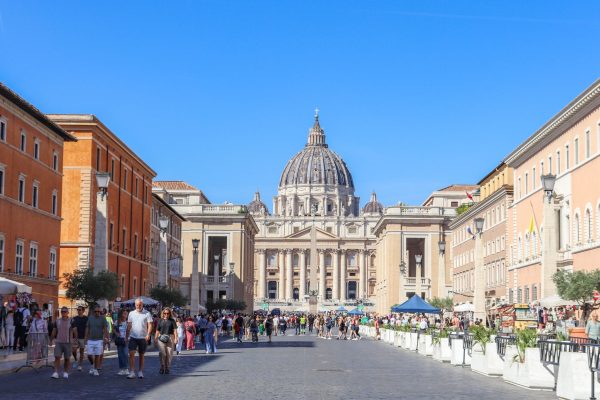
Today, the Basilica of Saint Peter in Vatican City stands over the traditional burial site of Saint Peter. The Basilica of Saint Paul Outside the Walls is associated with the traditional burial place of Saint Paul.
These sacred places remind Catholics of the sacrifices made by the Apostles and the generations of Christians who gave their lives for the Gospel.
The Church in Rome was built upon the witness of faith, the preaching of the Apostles, and the blood of the martyrs.
8. The Catholic Church Is Built on Jesus Christ
While Saint Peter and the other Apostles received important responsibilities, the Catholic Church teaches that Jesus Christ Himself is the foundation and head of the Church.
Saint Paul makes this clear in his First Letter to the Corinthians:
“For no other foundation can anyone lay than that which is laid, which is Jesus Christ.” (1 Corinthians 3:11)
Saint Peter also identifies Jesus as the living cornerstone:
“Come to him, to that living stone, rejected by men but in God’s sight chosen and precious.” (1 Peter 2:4)
The Church is therefore not the creation of a human leader or an institution established by political authority. It belongs to Jesus Christ.
He called the Apostles, gave them authority, sent them to preach the Gospel, and promised to remain with His Church.
In Matthew 28:20, Jesus gives His disciples this promise:
“And behold, I am with you always, to the close of the age.”
The Catholic Church believes that this promise remains true today.
Through the Apostolic Succession, the bishops continue the ministry entrusted to the Apostles, and the Pope, as the successor of Saint Peter, serves as the visible shepherd of the universal Church.
The Church continues to proclaim the same Gospel preached by the Apostles: Jesus Christ, crucified and risen, is Lord and Savior.
9. What Acts 23:11 Teaches Catholics Today
The words Jesus spoke to Saint Paul are not only an important part of Church history. They also offer a spiritual lesson to Christians today.
“Take courage!”
These words remind us that following Jesus does not mean we will never encounter difficulties.
Saint Paul faced imprisonment, threats, rejection, storms, and persecution. Yet the Lord encouraged him to continue his mission.
Sometimes God calls us to serve Him in places we never expected. Sometimes our journey is difficult, and we may not understand why certain challenges are happening.
But the example of Saint Paul teaches us to remain faithful and trust in God’s providence.
The Gospel must continue to be proclaimed, not only in Rome but throughout the entire world.
Every Catholic has a responsibility to bear witness to Jesus Christ through faith, prayer, charity, and the way we live.
We may never stand before an emperor or travel to distant countries to preach, but we can still bring Christ to our families, communities, workplaces, and neighbors.
The mission of the Apostles continues through the Church today.
Conclusion: The Apostolic Roots of the Catholic Church in Rome
The history of the Catholic Church in Rome is inseparable from the mission of Jesus Christ and the witness of His Apostles.
Acts 23:11 records the Lord’s promise that Saint Paul would testify about Him in Rome. Paul fulfilled that mission, proclaiming the Gospel even while under house arrest.
But the Christian community in Rome had already existed before his arrival. Catholic tradition connects the apostolic foundation of that Church especially with Saint Peter, whose unique role was entrusted to him by Jesus Christ, and with Saint Paul, the great Apostle to the Gentiles.
Their preaching, ministry, and martyrdom helped make Rome one of the most important centers of early Christianity.
The Catholic Church in Rome did not begin with an emperor. Its spiritual roots reach back to Jesus Christ, who called His Apostles, established His Church, and sent them into the world to proclaim the Gospel.
And the words of Jesus to Saint Paul continue to inspire Catholics today:
“Take courage! … you must also testify in Rome.” (Acts 23:11)
May we, like Saint Peter and Saint Paul, remain faithful witnesses to Jesus Christ and His Church.
Leave us your prayers…