
The Holy Eucharist is the heart and center of the Catholic faith. Every time Catholics attend Holy Mass, they gather around the altar to celebrate the greatest gift Jesus Christ gave to His Church: His own Body and Blood.
But why do Catholics believe that the Eucharist is truly the Body and Blood of Jesus Christ? Is the Eucharist simply a symbol of Jesus, or is Christ really present under the appearances of bread and wine?
The Catholic Church teaches that the Eucharist is not merely a symbol or a reminder of the Last Supper. It is truly Jesus Christ Himself, Body, Blood, Soul, and Divinity.
This belief comes directly from the words of Jesus Christ at the Last Supper and His teaching in the Gospel of John. It has been faithfully preserved by the Apostles and handed down through the centuries.
Let us explore what the Bible teaches about the Holy Eucharist and why Catholics believe in the Real Presence of Jesus Christ.
1. Jesus Christ Said: “This Is My Body”
The foundation of the Catholic belief in the Eucharist is found in the words Jesus spoke during the Last Supper.
On the night before His Passion and death, Jesus gathered with His Apostles to celebrate the Passover meal. During this sacred meal, He took bread, blessed it, broke it, and gave it to His disciples.
The Gospel of Matthew records:
“Take and eat; this is my body.” (Matthew 26:26)
Then Jesus took the cup and said:
“Drink from it, all of you, for this is my blood of the covenant, which will be shed on behalf of many for the forgiveness of sins.” (Matthew 26:27–28)
Jesus did not say, “This represents my Body” or “This symbolizes my Blood.”
He said: “This is my Body” and “This is my Blood.”
Catholics believe that Jesus meant exactly what He said. Through the power of the Holy Spirit and the ministry of the ordained priest, the bread and wine become the Body and Blood of Christ during the celebration of the Holy Eucharist.
This is why Catholics approach Holy Communion with reverence, faith, and love. We believe that we are receiving Jesus Himself.
2. Jesus Promised to Give Us His Flesh to Eat
One of the clearest teachings about the Eucharist is found in John chapter 6, where Jesus speaks about the Bread of Life.
After feeding five thousand people with five loaves and two fish, Jesus taught the crowds about the true bread that comes down from Heaven.
He declared:
“I am the living bread that came down from heaven; whoever eats this bread will live forever; and the bread that I will give is my flesh for the life of the world.” (John 6:51)
The people struggled to understand His words. They asked:
“How can this man give us his flesh to eat?” (John 6:52)
Jesus did not withdraw His teaching. Instead, He repeated it with even greater emphasis:
“Amen, amen, I say to you, unless you eat the flesh of the Son of Man and drink his blood, you do not have life within you.” (John 6:53)
He continued:
“Whoever eats my flesh and drinks my blood has eternal life, and I will raise him on the last day.” (John 6:54)
These words are central to Catholic Eucharistic belief.
Jesus teaches that His flesh is true food and His blood is true drink. Catholics believe that this promise is fulfilled in the Holy Eucharist.
The Eucharist is therefore not an ordinary meal. It is a sacred gift through which Christ gives Himself to us and nourishes our spiritual life.
3. What Is the Real Presence of Jesus in the Eucharist?
The Catholic Church teaches that Jesus Christ is truly, really, and substantially present in the Holy Eucharist.
This means that when the priest consecrates the bread and wine during Holy Mass, their substance is changed into the Body and Blood of Jesus Christ.
The appearances of bread and wine remain, but their substance becomes Christ Himself.
The Church calls this miracle Transubstantiation.
According to the Catechism of the Catholic Church, Christ becomes present in the Eucharist through the conversion of the whole substance of bread into His Body and the whole substance of wine into His Blood.
Jesus is not divided. He is wholly present, Body, Blood, Soul, and Divinity, under each Eucharistic species.
This means that Catholics do not receive only a part of Jesus when receiving Holy Communion. They receive the whole Christ.
Although our eyes see bread and wine, faith teaches us that Jesus is truly present.
This is one of the greatest mysteries of our Catholic faith.

4. The Eucharist Is the Sacrifice of Jesus Made Present
Catholics believe that the Holy Mass is not simply a gathering to remember Jesus or a repetition of the Last Supper.
The Eucharist makes present the one sacrifice of Jesus Christ on Calvary in a sacramental and unbloody manner.
Jesus offered Himself once and for all on the Cross for the salvation of humanity. His sacrifice is never repeated, because His offering was perfect and complete.
During Holy Mass, the Church participates sacramentally in that same sacrifice.
The Catechism of the Catholic Church teaches:
“The sacrifice of Christ and the sacrifice of the Eucharist are one single sacrifice.” (CCC 1367)
This is why the Mass is so sacred and important.
When we attend Holy Mass, we join the Church in offering worship and thanksgiving to God. We remember the Passion, death, and Resurrection of Jesus Christ, and we receive the fruits of His saving sacrifice.
The Eucharist brings us into communion with the sacrifice of Our Lord and Savior.
5. The Early Christians Believed in the Real Presence
The Catholic belief in the Eucharist is not a new teaching invented centuries after Jesus.
From the earliest centuries, Christians believed that the Eucharist was truly the Body and Blood of Christ.
Saint Ignatius of Antioch, an early bishop and martyr who lived around the end of the first century and beginning of the second century, wrote about the Eucharist in his Letter to the Smyrnaeans.
He defended the reality of Christ’s flesh and described the Eucharist as the flesh of Jesus Christ.
Saint Justin Martyr, writing in the second century, also explained that Christians did not receive the Eucharist as ordinary bread and drink. He taught that it was the flesh and blood of Jesus Christ.
These early Christian witnesses demonstrate how deeply the Eucharist was rooted in the faith and worship of the early Church.
The Apostles handed down the teachings of Jesus, and the early Christians continued to celebrate the Eucharist as the sacred gift Christ entrusted to His Church.
6. Why Do Catholics Kneel Before the Eucharist?
When Catholics enter a church, they often genuflect before the tabernacle. During Eucharistic adoration, Catholics kneel before the Blessed Sacrament and pray in silence.
Why?
Because Catholics believe that Jesus Christ is truly present in the Eucharist.
The consecrated Host is not ordinary bread. It is Jesus Himself, and therefore He deserves our worship and adoration.
The Church teaches that the Eucharist is worthy of the worship of adoration because it contains Christ Himself.
This is why Catholics celebrate Eucharistic adoration, processions with the Blessed Sacrament, and special feasts such as the Solemnity of the Most Holy Body and Blood of Christ, commonly known as Corpus Christi.
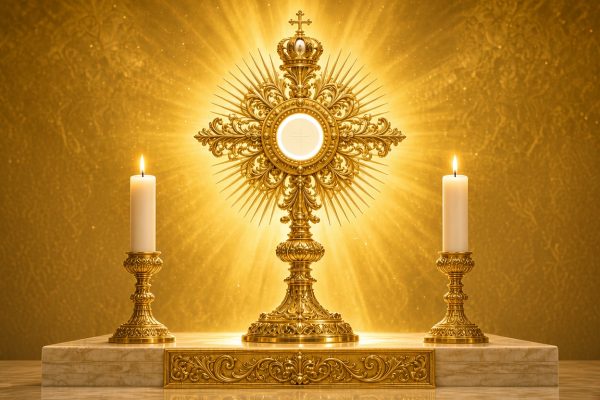
During Eucharistic adoration, the Blessed Sacrament is often placed in a monstrance so that the faithful can pray before Jesus.
It is a beautiful opportunity to spend time with Our Lord, thank Him, ask for His mercy, and place our worries and intentions before Him.
7. The Eucharist Unites Us With Jesus Christ
Holy Communion is not simply receiving a religious blessing. It is entering into a profound union with Jesus Christ.
Jesus said:
“Whoever eats my flesh and drinks my blood remains in me and I in him.” (John 6:56)
Through Holy Communion, Christ nourishes our spiritual life and strengthens our relationship with Him.
The Eucharist helps us grow in faith, charity, and holiness. It gives us spiritual strength to resist sin, forgive others, love our neighbors, and follow the teachings of Jesus.
The Eucharist also unites us with the entire Church. When we receive the Body of Christ, we become more deeply united with Christ and with our brothers and sisters in the faith.
This is why Catholics should never approach Holy Communion casually. We should prepare our hearts through prayer, repentance, and a sincere desire to follow Jesus.
8. Can Catholics Receive the Eucharist Without Confession?
Catholics should receive Holy Communion with a heart that is properly prepared.
The Church teaches that anyone conscious of having committed a mortal sin must receive the Sacrament of Reconciliation before receiving Holy Communion.
Saint Paul gives an important warning:
“Therefore whoever eats the bread or drinks the cup of the Lord unworthily will have to answer for the body and blood of the Lord.” (1 Corinthians 11:27)
He also writes:
“A person should examine himself, and so eat the bread and drink the cup.” (1 Corinthians 11:28)
These words remind us that receiving the Eucharist is a sacred responsibility.
Catholics who are conscious of mortal sin should first go to Confession and receive God’s forgiveness before approaching Holy Communion.
However, Catholics who are not conscious of mortal sin are encouraged to receive Holy Communion frequently, provided they are properly disposed and observe the Church’s requirements, including the Eucharistic fast.
The Eucharist is a gift of God’s love, and we should always approach it with humility and reverence.
9. Why Is the Eucharist Called the Source and Summit of Christian Life?
The Catechism of the Catholic Church describes the Eucharist as “the source and summit of the Christian life” (CCC 1324).
Why is it so important?
Because the Eucharist contains Jesus Christ Himself, the source of our salvation.
Everything in the Christian life leads us toward union with God, and the Eucharist is the most sacred way Christ gives Himself to His Church.
Through the Eucharist:
- We receive Jesus Christ, truly present in His Body and Blood.
- We participate in the one sacrifice of Christ.
- We receive spiritual nourishment and strength.
- We grow in our relationship with Jesus.
- We are united more deeply with the Church.
- We receive a foretaste of the heavenly banquet.
The Eucharist reminds us that Jesus has never abandoned His Church. He remains with us, giving Himself to us until the end of time.
10. How Can We Show Greater Love and Reverence for the Holy Eucharist?
As Catholics, we should never take the gift of the Eucharist for granted.
Every Holy Mass is an opportunity to encounter Jesus Christ and receive His grace.
Here are several ways to deepen our love for the Blessed Sacrament:
Attend Holy Mass faithfully. Make Sunday Mass a priority and participate with attention, prayer, and devotion.
Prepare your heart before receiving Communion. Examine your conscience, seek forgiveness when necessary, and approach the altar with humility.
Spend time in Eucharistic adoration. Visit Jesus in the Blessed Sacrament. Even a few minutes of silent prayer can deepen your relationship with Him.
Give thanks after Holy Communion. After receiving Jesus, take time to pray and thank Him for the extraordinary gift of His presence.
Pray for a deeper faith. Ask the Lord to strengthen your belief in His Real Presence and help you love Him more each day.
Frequently Asked Questions About the Catholic Eucharist
1. Do Catholics believe the Eucharist is really Jesus?
Yes. Catholics believe that Jesus Christ is truly, really, and substantially present in the Holy Eucharist, Body, Blood, Soul, and Divinity. The bread and wine become His Body and Blood during the consecration at Mass.
2. What Bible verse supports the Catholic belief in the Eucharist?
Several important passages support this teaching, especially Matthew 26:26–28, John 6:51–56, Luke 22:19–20, and 1 Corinthians 11:23–29.
3. What is transubstantiation in the Catholic Church?
Transubstantiation is the miraculous change of the whole substance of bread and wine into the Body and Blood of Jesus Christ during the consecration, while the appearances of bread and wine remain.
4. Why do Catholics worship the Eucharist?
Catholics adore the Eucharist because they believe Jesus Christ Himself is truly present in the Blessed Sacrament. Worship is given to Christ, not to ordinary bread.
5. What is the difference between the Eucharist and Holy Communion?
The Eucharist refers to the sacrament and the celebration of the Holy Mass, while Holy Communion refers particularly to receiving the Body and Blood of Christ. Both expressions are closely connected.
6. Who instituted the Holy Eucharist?
Jesus Christ instituted the Holy Eucharist at the Last Supper, when He took bread and wine, blessed them, and gave them to His Apostles as His Body and Blood.
7. How often should Catholics receive Holy Communion?
Catholics are required to receive Holy Communion at least once a year during the Easter season, provided they are properly disposed. The Church strongly encourages frequent and even daily reception when properly prepared.
Conclusion: Jesus Christ Is Truly Present in the Holy Eucharist
The Holy Eucharist is the greatest gift Jesus Christ gave to His Church.
At the Last Supper, He gave His Apostles His Body and Blood and commanded them to continue this sacred celebration in His memory.
Through the Holy Mass, Catholics encounter the same Jesus who was born in Bethlehem, preached in Galilee, suffered on Calvary, rose from the dead, and ascended into Heaven.
He is truly present in the Blessed Sacrament.
When we approach the altar to receive Holy Communion, we are not receiving an ordinary piece of bread. We are receiving Our Lord Jesus Christ Himself.
Let us never take this extraordinary gift for granted. May we approach the Holy Eucharist with faith, love, humility, and reverence.
Lord Jesus Christ, increase our faith in Your Real Presence in the Holy Eucharist. Help us to love You more deeply, receive You worthily, and remain united with You throughout our lives. Amen.
Leave us your prayers…