
Have you ever wondered why Catholics call their priests “Father”? Some Christians question this Catholic tradition because Jesus said in the Gospel of Matthew, “Call no man your father upon earth: for one is your Father, who is in heaven” (Matthew 23:9, Douay-Rheims).
Does calling a priest “Father” contradict the words of Jesus? Why do Catholics use this title, and where does this tradition come from?
The answer is found in understanding the meaning of Jesus’ teaching, the spiritual fatherhood described throughout the Bible, and the mission of Catholic priests.
Catholics call their priests “Father” because priests serve as spiritual fathers to their communities. They teach the faith, administer the Sacraments, guide souls, celebrate the Holy Mass, and help people grow closer to God.
This title does not mean that priests take the place of God the Father. Rather, it recognizes their spiritual responsibility to care for the faithful, just as a father cares for his children.
Let’s explore what the Bible and the Catholic Church teach about this beautiful tradition.
1. Did Jesus Say We Should Not Call Anyone Father?
The most common question about calling priests “Father” comes from Matthew 23:9:
“And call none your father upon earth; for one is your Father, who is in heaven.”
At first glance, this verse might seem to prohibit Christians from calling anyone their father. However, we must read it in its proper context.
In Matthew 23, Jesus speaks strongly against the scribes and Pharisees because some of them sought honor, recognition, and positions of importance. They loved being noticed, receiving prestigious titles, and appearing righteous before others while neglecting humility and justice.
Jesus was teaching His disciples not to seek spiritual superiority, pride, or human glory.
He was not teaching that the words father, teacher, or master must never be used for human relationships.
If Jesus intended to forbid the use of the word father in every circumstance, we would encounter difficulties with other passages of Scripture.
For example, the Bible itself speaks of fathers in families, spiritual fathers, and Abraham as the father of believers.
The important distinction is that God alone is the ultimate source of all fatherhood. Human fatherhood is a gift that reflects His divine fatherhood.
Catholics therefore understand Matthew 23:9 as a warning against pride and the desire to replace God, not as a prohibition against recognizing spiritual fatherhood.
2. Saint Paul Called Himself a Spiritual Father
One of the clearest biblical explanations for spiritual fatherhood comes from Saint Paul.
In his First Letter to the Corinthians, Saint Paul writes:
“For if you have ten thousand instructors in Christ, yet not many fathers. For in Christ Jesus, by the gospel, I have begotten you.”
(1 Corinthians 4:15, Douay-Rheims)
This passage is especially important when discussing why Catholics call priests Father.
Saint Paul explains that although the Corinthians had many teachers, he had become their spiritual father through the preaching of the Gospel.
He had brought them to faith in Jesus Christ, instructed them in Christian life, and cared for their spiritual growth.
He did not claim to replace God the Father. Instead, he understood his spiritual fatherhood as a responsibility received through Christ.
Saint Paul even encourages the Corinthians to imitate him, just as he imitates Christ (1 Corinthians 11:1).
This shows that spiritual fatherhood is not about receiving personal glory. It is about leading others toward Jesus.
Catholics see a similar responsibility in the ministry of priests. A priest is called to guide his spiritual children, teach the Gospel, celebrate the Sacraments, and help the faithful remain close to Christ.
3. Abraham Is Called the Father of Many Nations
The Bible provides another important example of spiritual fatherhood through Abraham.
In Genesis 17:4, God makes a covenant with Abraham and tells him:
“And I shall make my covenant between me and thee: and I will multiply thee exceedingly.”
God promises that Abraham will become the father of many nations.
Saint Paul also refers to Abraham as the father of all who believe (Romans 4:11–12).
In Romans 4:16, Saint Paul explains that Abraham is the father of us all.
Why is this important?
Because Scripture uses the word father to describe a spiritual relationship, not only a biological one.
Abraham became the father of believers because of his faith and obedience to God.
This biblical understanding helps Catholics recognize that spiritual fatherhood can exist without taking anything away from the unique fatherhood of God.
4. The Priest Represents Christ, the Good Shepherd
Catholic priests are called to serve the faithful in the person of Christ, especially in their sacramental ministry.
Jesus describes Himself as the Good Shepherd:
“I am the good shepherd. The good shepherd giveth his life for his sheep.”
(John 10:11, Douay-Rheims)
A shepherd does not seek to control the sheep for his own benefit. He protects them, guides them, and leads them toward safety.
This is also the mission of a Catholic priest.
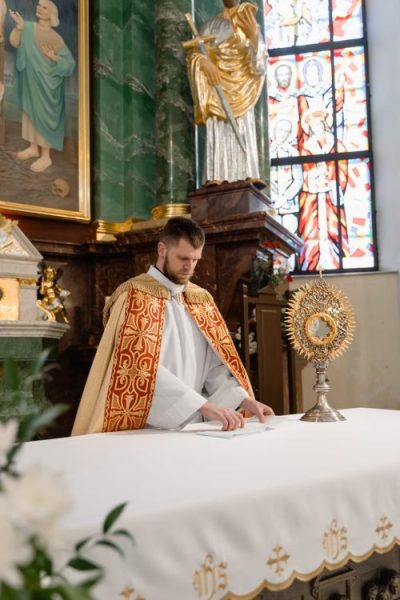
A priest is entrusted with the spiritual care of his parish community. He celebrates the Holy Mass, hears confessions, baptizes children, visits the sick, teaches the faith, and accompanies people through important moments in their lives.
When Catholics call their priest “Father,” they recognize this spiritual responsibility.
The title is meant to remind priests that their ministry must reflect the love, patience, sacrifice, and compassion of Jesus Christ.
A faithful priest should never seek admiration for himself. His mission is to lead people to Christ.
5. Priests Help Us Grow Through the Sacraments
One of the most important responsibilities of a Catholic priest is administering the Sacraments.
Through the Sacraments, Christ continues His saving work in the Church.
A priest baptizes new members into the Christian community, celebrates the Eucharist, offers absolution in the Sacrament of Reconciliation, anoints the sick, and assists couples in celebrating the Sacrament of Matrimony.
The priest’s ministry is especially visible during the Holy Mass.
At the altar, he celebrates the Eucharist according to the command of Jesus at the Last Supper:
“Do this for a commemoration of me.”
(Luke 22:19, Douay-Rheims)
Catholics believe that Christ is truly present in the Eucharist. The priest does not act through his own power but exercises the ministry entrusted to the Church through Holy Orders.
This sacramental responsibility is one reason the Church recognizes priests as spiritual fathers.
They help nourish the faithful with the Word of God and the Bread of Life.
6. The Early Christians Recognized Spiritual Fatherhood
The practice of recognizing spiritual fathers did not suddenly appear in modern Catholicism.
From the earliest centuries, Christians understood that those entrusted with teaching and guiding the Church had a spiritual responsibility toward the faithful.
The apostles appointed leaders and elders to care for Christian communities (Acts 14:23; Titus 1:5).
Saint Paul also described his relationship with Timothy in fatherly terms.
He wrote:
“To Timothy my dearly beloved son in faith.”
(1 Timothy 1:2, Douay-Rheims)
Paul was not Timothy’s biological father. He was his spiritual father, having guided him in the Christian faith.
The early Church also developed a rich tradition of spiritual guidance, especially through bishops, priests, and monastic fathers.
The title Father became an expression of spiritual care, guidance, and responsibility.
It is important to understand that Catholic spiritual fatherhood is not intended to give priests superiority over other Christians. It is a call to service.
7. What Does the Catholic Church Teach About Calling Priests Father?
The Catholic Church teaches that priests participate in the one priesthood of Jesus Christ.
Jesus Christ is the one true High Priest, and the ordained priesthood exists to serve His mission in the Church.
The Catechism of the Catholic Church explains that the ministerial priesthood differs in essence from the common priesthood of all the faithful, even though both participate in Christ’s one priesthood (CCC 1547).
The priest is ordained to serve the People of God through preaching, worship, and the administration of the Sacraments.
The title “Father” expresses this spiritual service.
It does not mean that a priest has the same authority as God, nor does it mean that Catholics worship or place priests above Christ.
In fact, the Church teaches that priests must remain humble servants of the Gospel.
A priest’s authority is not meant for personal glory. It is entrusted to him for the spiritual good of the faithful.
8. Does Calling a Priest Father Mean We Worship Him?
Absolutely not.
Catholics worship God alone: the Father, the Son, and the Holy Spirit.
We do not worship priests, bishops, or the Pope.
The title “Father” is an expression of respect for the spiritual role of a priest.
Just as calling someone a teacher does not mean that person is greater than God, calling a priest Father does not place him above our Heavenly Father.
A priest remains a human being who needs God’s mercy, forgiveness, and grace.
He can make mistakes and is called to continually grow in holiness.
Catholics are encouraged to respect their priests, pray for them, and support them in their ministry, while remembering that every priest is ultimately accountable to God.
9. Why Is Spiritual Fatherhood So Important Today?
In today’s world, many people struggle with loneliness, uncertainty, family difficulties, and a loss of spiritual direction.
The role of a faithful Catholic priest is especially important in these circumstances.
A good priest can become a spiritual guide who helps people rediscover their relationship with God.
He can encourage a struggling person to return to prayer, offer the Sacrament of Reconciliation, comfort a grieving family, visit someone who is sick, and remind the faithful of the hope found in Jesus Christ.
A priest is also called to teach the truth of the Gospel, even when it is difficult or unpopular.
However, spiritual fatherhood must always be exercised with love, humility, and respect.
A priest should never use his position to manipulate, intimidate, or harm others. True spiritual fatherhood reflects the loving example of Jesus, who came not to be served but to serve (Mark 10:45).
We should also remember to pray for our priests. They carry great responsibilities and need the prayers and encouragement of the faithful.
10. How Should Catholics Respect Their Priests?
Calling a priest Father is one way Catholics express respect for his vocation and ministry.
We can also support our priests through prayer, kindness, encouragement, and participation in parish life.
Here are a few simple ways to support Catholic priests:
- Pray daily for your parish priest and all priests.
- Attend Holy Mass and participate faithfully in parish life.
- Encourage priests who faithfully serve their communities.
- Remember priests in your prayers, especially those who are elderly, sick, or isolated.
- Ask God to strengthen priests who face difficulties in their ministry.
- Pray for young men who are discerning a vocation to the priesthood.
The priesthood is not an easy vocation. It requires sacrifice, dedication, and a willingness to serve God’s people.
Our priests need our prayers just as much as we need their spiritual ministry.
Conclusion: A Father Who Leads Us to Our Heavenly Father
Why do Catholics call their priests Father?
Because the Bible recognizes spiritual fatherhood, Saint Paul describes himself as a spiritual father to those he brought to Christ, and the Catholic priest is entrusted with caring for the spiritual lives of the faithful.
Jesus’ words in Matthew 23:9 remind us that God alone is our ultimate Father and the source of all fatherhood. They also warn us against pride, vanity, and the misuse of spiritual authority.
Calling a priest Father does not take anything away from God. Instead, it recognizes the responsibility of a priest to serve God’s children and lead them closer to Jesus Christ.
A good priest does not want people to follow him instead of Christ. He wants to help them know Christ, love Christ, receive His grace, and remain faithful to Him.
Let us remember to pray for our priests, respect their vocation, and ask the Lord to raise up holy and faithful shepherds for His Church.
May God bless all our priests and strengthen them in their sacred ministry. Amen.
Frequently Asked Questions
1. Why do Catholics call priests Father?
Catholics call priests Father because they serve as spiritual fathers to their communities. They teach the Gospel, administer the Sacraments, guide souls, and help the faithful grow in their relationship with Jesus Christ.
2. Does the Bible forbid calling priests Father?
No. Matthew 23:9 warns against pride and the desire to take the place of God. Saint Paul himself uses the language of spiritual fatherhood in 1 Corinthians 4:15, where he describes himself as a father to the Corinthians through the Gospel.
3. Did Saint Paul call himself a spiritual father?
Yes. In 1 Corinthians 4:15, Saint Paul explains that he became a spiritual father to the Corinthians through the preaching of the Gospel and their conversion to Christ.
4. Do Catholics worship priests?
No. Catholics worship God alone. Calling a priest Father is a sign of respect for his spiritual ministry, not an act of worship.
5. Why is a Catholic priest considered a spiritual father?
A priest is entrusted with the spiritual care of the faithful. Through preaching, celebrating the Eucharist, hearing confessions, and administering the Sacraments, he helps guide people toward holiness and eternal life.
6. What does Jesus mean when He says God is our Father?
Jesus teaches that God is the ultimate source of life, love, and fatherhood. Every form of human and spiritual fatherhood must reflect God’s divine fatherhood and never replace it.
7. Should Catholics pray for their priests?
Yes. Catholics should regularly pray for priests, asking God to give them wisdom, holiness, strength, and perseverance in their vocation.
A Short Prayer for Our Priests
Heavenly Father, we thank You for the gift of the Catholic priesthood. Bless all priests who serve Your Church. Give them strength in times of difficulty, wisdom in their decisions, humility in their ministry, and love for the people entrusted to their care.
Protect them from temptation, renew their faith, and help them become faithful shepherds after the Heart of Jesus.
Bless our parish priests, missionaries, bishops, and all those who have dedicated their lives to serving Your Church.
Through Jesus Christ our Lord. Amen.
Saint John Vianney, patron saint of parish priests, pray for our priests!
Scripture References
- Matthew 23:8–12 – Jesus teaches humility and warns against seeking titles.
- 1 Corinthians 4:15 – Saint Paul describes his spiritual fatherhood.
- Romans 4:16 – Abraham is called the father of believers.
- 1 Timothy 1:2 – Saint Paul calls Timothy his beloved son in faith.
- John 10:11 – Jesus is the Good Shepherd.
- Luke 22:19 – Jesus institutes the Eucharist.
- Mark 10:45 – Jesus comes to serve, not to be served.
Catholic Church References
- Catechism of the Catholic Church, paragraphs 1547–1551: The ministerial priesthood.
- Catechism of the Catholic Church, paragraph 1536: The Sacrament of Holy Orders.
- Catechism of the Catholic Church, paragraph 1551: The priesthood as service.
Leave us your prayers…