
With over 1.3 billion members spanning every continent, the Catholic Church is the oldest and largest Christian institution in the world. Yet despite its visibility in history, art, and culture, Catholicism remains one of the most misunderstood faiths on earth.
Many of these misunderstandings stem from centuries-old historical divisions, pop culture tropes, or simple confusion over religious terminology. When someone steps into a Catholic parish for the first time—or discusses faith with a Catholic friend—they often carry assumptions about what Catholics believe that are completely contrary to actual Church teaching.
Whether you are a non-Catholic curious about what the Church really teaches, or a Catholic looking for a clear, charitable way to explain your faith to family and friends, here are seven of the biggest misconceptions about the Catholic Church—and the truth behind them.
1. Myth: Catholics Worship Mary and the Saints
Walk into almost any Catholic church, and you will see statues of the Virgin Mary, stained-glass windows of the Apostles,and candles flickering before images of saints. To an outside observer—especially one raised in a tradition that strictly avoids religious imagery—this can easily look like idolatry.
The Reality: Catholics worship God alone. In Catholic theology, there is a strict, non-negotiable distinction between worship (latria), which belongs exclusively to God, and veneration (dulia), which is deep honor and respect given to the saints.
When Catholics pray to Mary or the saints, they are not treating them as miniature gods who grant wishes on their own power. Rather, the word “pray” is used in its older, traditional English sense, meaning “to ask” or “to petition” (similar to the phrase “pray tell”). Asking Saint Jude or the Virgin Mary to pray for you is no different in principle than asking a close friend, a pastor, or a family member to pray for you when you are going through a difficult time.
Because Catholics believe that death does not sever the bond of the Body of Christ, those who have died in God’s grace are very much alive in heaven. As Scripture says, “The prayer of a righteous person has great power as it is working”(James 5:16). Who could be more righteous than those already perfected in heaven? Catholics honor Mary and the saints as spiritual family members, role models of faith, and powerful prayer partners who bring our needs directly to Jesus.
2. Myth: Catholics Believe They Can “Buy” or “Earn” Their Way into Heaven
One of the most persistent myths dating back to the 16th-century Protestant Reformation is that Catholics practice “works salvation”—the idea that if you say enough Rosaries, attend enough Masses, or give enough money to charity, you can essentially purchase your ticket to heaven.
The Reality: The Catholic Church explicitly condemns the heresy of Pelagianism, which claims human beings can earn salvation through their own efforts without God’s grace. The Catechism of the Catholic Church states clearly that no one can merit the initial grace of forgiveness and eternal life; salvation is a completely free, unmerited gift won by Jesus Christ on the Cross.
Where the confusion usually arises is in how Catholics understand the relationship between faith and works. Catholics believe that true, saving faith is never merely an intellectual agreement; it must be active, living, and expressed through love. As the Apostle James wrote, “So also faith by itself, if it does not have works, is dead” (James 2:17).
Good works do not earn salvation—rather, good works are the evidence and fruit of God’s grace working inside a believer’s heart. Furthermore, when abuses occurred in the late Middle Ages involving the selling of indulgences by corrupt preachers, the Church formally banned the practice at the Council of Trent in 1567. Today, you cannot buy an indulgence, a blessing, or a place in heaven.
3. Myth: Catholics Aren’t Allowed to Read the Bible (or Don’t Know Scripture)
There is a widespread stereotype that the Catholic Church kept the Bible locked away in Latin to keep believers ignorant,and that modern Catholics rely solely on human tradition while ignoring the Word of God.
The Reality: Not only are Catholics encouraged to read the Bible daily, but the Catholic Church is actually the institution that compiled and preserved the New Testament in the first place. During the first three centuries of Christianity, dozens of conflicting letters and gospels circulated among early believers. It was through Catholic Church councils in the late fourth century—specifically the Councils of Rome (382), Hippo (393), and Carthage (397)—that the Church officially discerned which 27 books were divinely inspired and belonged in the New Testament canon.
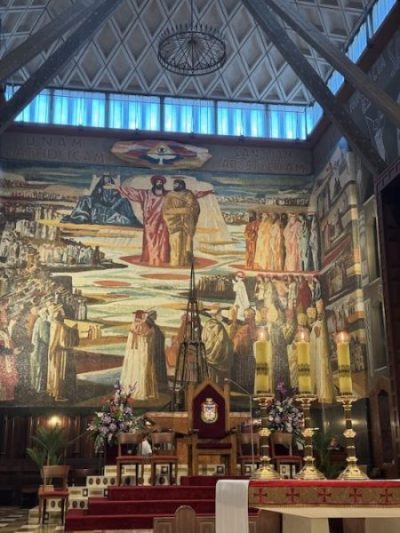
Before the invention of the printing press in the 1440s, every single Bible had to be copied by hand by Catholic monks—a process that took over a year and cost the equivalent of a small house. Because books were rare and literacy rates were low, the Church painted Scripture stories on stained glass and cathedral walls so everyone could learn the Gospel visually.
Today, if you attend a Catholic Mass, you will find it is saturated with Scripture from start to finish. Every Sunday Mass includes a reading from the Old Testament, a Psalm, a reading from the New Testament Epistles, and a reading from the Gospels. Even the prayers spoken by the priest and congregation are woven directly from biblical verses. If a Catholic attends daily Mass for three years, they will hear virtually the entire Bible proclaimed aloud.
4. Myth: The Pope Is Sinless and Can Make Up New Doctrines Whenever He Wants
When the Pope speaks to the media or writes a new document, headlines often treat his every word as an infallible decree that rewrites 2,000 years of Christian belief. Many non-Catholics assume that “papal infallibility” means the Pope never sins, never makes mistakes, and acts as an absolute dictator over truth.
The Reality: Papal infallibility is one of the most narrowly defined doctrines in Catholicism—and it has nothing to do with the Pope being personally sinless. Catholics know very well that popes are human beings who sin and go to Confession just like every other believer. In fact, the very first Pope, Saint Peter, denied Jesus three times and was publicly corrected by Saint Paul.
Infallibility simply means that when the Pope speaks ex cathedra (from the Chair of Peter) in his official capacity as universal pastor to solemnly define a doctrine concerning faith or morals to be held by the entire Church, the Holy Spirit prevents him from teaching error. This power is so rare and strictly bounded that it has only been formally invoked twice in the last 170 years (regarding the Immaculate Conception in 1854 and the Assumption of Mary in 1950).
Moreover, the Pope cannot invent new doctrines. His job is not to innovate, but to guard and faithfully hand down the “Deposit of Faith” passed down from Jesus and the Apostles. If a pope expressed a personal opinion on politics, sports, or economics during an airplane interview, no Catholic is bound to treat that opinion as infallible truth.
5. Myth: Purgatory Is a “Second Chance” for People Who Rejected God
In movies and popular fiction, Purgatory is often depicted as a gloomy waiting room or a cosmic courtroom where souls sit around hoping to get a second chance at salvation after dying in mortal sin.
The Reality: Purgatory is not a “second chance,” nor is it a middle ground between heaven and hell. Every single soul in Purgatory is already saved and guaranteed entry into heaven.
The concept of Purgatory rests on two straightforward biblical truths: first, that nothing unclean can enter the presence of God in heaven (Revelation 21:27), and second, that most believers die still clinging to minor selfishness, bad habits, or unresolved attachments to sin—even though they genuinely love God and have been forgiven.
Think of Purgatory as a spiritual mudroom or a hospital for the soul. If you were invited to a royal wedding banquet, but you arrived covered in mud from a long journey, you wouldn’t want to walk straight onto the white ballroom floor looking like that—you would want to wash up first so you could enjoy the feast properly. Purgatory is that final, merciful purification by God’s love, burning away the remaining selfishness in our hearts so we can stand before the Almighty in pure joy.
6. Myth: Confession Means Priests Forgive Sins on Their Own Authority
Many Christians from other denominations object to the Catholic Sacrament of Reconciliation (Confession) by quoting the Bible: “Who can forgive sins but God alone?” (Mark 2:7). To them, telling your sins to a priest seems like putting an unnecessary human middleman between a believer and Jesus.
The Reality: Catholics agree 100% that only God can forgive sins. A priest has zero power of his own to wipe away a single sin. Rather, Catholics believe that Jesus Christ explicitly chose to exercise His divine forgiveness through His Apostles and their successors.
On the evening of His Resurrection, Jesus appeared to the Apostles in the Upper Room, breathed on them, and gave them a specific mission: “Receive the Holy Spirit. If you forgive the sins of any, they are forgiven them; if you retain the sins of any, they are retained” (John 20:22–23). Jesus didn’t give them the power to read minds—which means the only way the Apostles could know whether to forgive or retain someone’s sins was if the person actually confessed them aloud.
When a Catholic goes to Confession, the priest acts in persona Christi (“in the person of Christ”) as an instrument of God’s mercy, much like a doctor administers medicine on behalf of a hospital. Confession isn’t a barrier between the soul and God; it is a tangible encounter with Christ’s grace where a believer hears the audible words, “I absolve you from your sins in the name of the Father, and of the Son, and of the Holy Spirit,” leaving with certainty that they are forgiven and reconciled with both God and the Church.
7. Myth: Catholics Repeat the Same “Crucifying” of Jesus at Every Mass
Because Catholics believe the Eucharist is truly the Body and Blood of Christ, critics sometimes accuse the Church of re-sacrificing Jesus every single Sunday—claiming that Catholics ignore the book of Hebrews, which states that Christ died “once for all” (Hebrews 10:10).
The Reality: The Catholic Church teaches unequivocally that Jesus died only once on Calvary, and His sacrifice can never be repeated. Jesus is not killed, harmed, or sacrificed anew at Mass.
Instead, the Mass is a re-presentation—meaning it makes that one, eternal sacrifice of Calvary present across time and space. Because Jesus is God, His offering on the Cross was not merely a past historical event trapped in the first century; it is an eternal reality before God the Father.
When Catholics gather at Mass, they aren’t starting a new sacrifice—they are stepping outside of ordinary time to stand at the foot of the Cross alongside Mary and John, uniting their own prayers, struggles, and lives to Jesus’s single, completed offering. That is why Jesus commanded His disciples at the Last Supper, “Do this in remembrance of me”—using the Greek word anamnesis, which means far more than just thinking about the past; it means making a past saving event actively present here and now.
Looking Beyond the Stereotypes
You don’t have to agree with every Catholic teaching to recognize that the actual beliefs of the Church are far deeper,more biblical, and more coherent than the caricatures often repeated online. When you strip away centuries of misunderstandings, what remains is a faith centered entirely on Jesus Christ, rooted in Sacred Scripture, and preserved by a community striving to follow Him across two millennia.
Leave us your prayers…